
Metal-Stressed Vegetation (MSV)

Dense vegetation doesn’t have to hide exploration targets — it may help reveal them.
In forested and tropical terrains, direct geological observation is often limited by dense canopy cover. In such environments, vegetation can act as a secondary indicator of surface conditions, may reflect longer-term interactions between plants, soils, and geochemistry rather than serving only as an obstacle to mapping.
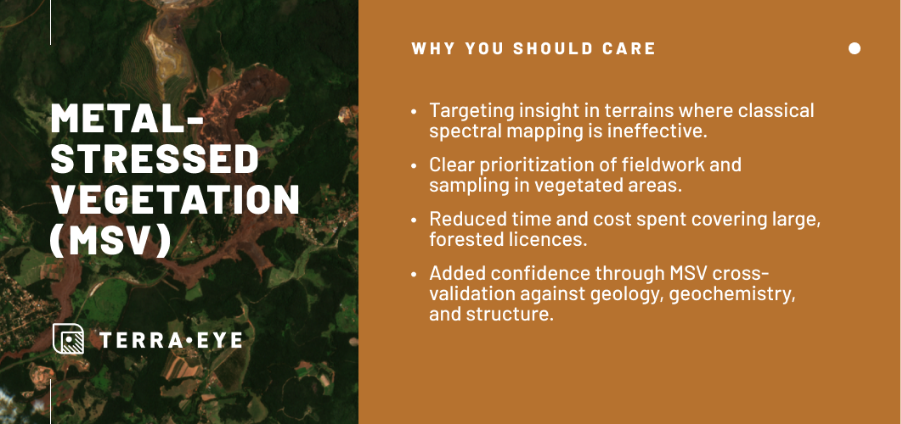
TerraEye applies a Metal-Stressed Vegetation (MSV) analysis, a vegetation stress metric designed to support mineral exploration in areas with limited surface exposure. The approach is based on multi-temporal satellite imagery (e.g. Sentinel-2) and focuses on how vegetation behaves over time, rather than relying on single-date observations.
MSV integrates information on vegetation greenness, canopy structure, and short-wave infrared (SWIR) response into a single, continuous indicator of plant stress. Unlike traditional vegetation indices that focus primarily on chlorophyll and tend to saturate in dense canopies, MSV is sensitive to early and subtle physiological changes in vegetation that may be associated with underlying geochemical processes.
Vegetation growing above chemically altered or metal-affected ground can exhibit a combination of stress responses, including:
- reduced chlorophyll concentration,
- changes in internal leaf structure,
- altered water content and moisture balance within leaf tissues.
By incorporating SWIR wavelengths sensitive to leaf moisture and turgor pressure, MSV may detect stress signals before visible discoloration or canopy thinning becomes apparent. This makes the method particularly useful in regions where direct surface mineral mapping is constrained by vegetation cover.
The output of the analysis is a vegetation stress anomaly map highlighting spatially coherent and temporally persistent zones of residual stress, identified after accounting for typical seasonal vegetation behavior. While MSV does not determine the exact cause of vegetation stress, these anomalies may, in some geological settings, spatially coincide with mineralised systems, alteration halos, or metal dispersion within soils and regolith.
MSV is not a replacement for field mapping, geochemistry, or geophysics. Instead, it provides an additional, independent targeting layer that helps guide exploration decisions in areas where surface exposure is poor. By integrating MSV results with geological, geochemical, and structural information, exploration teams can better prioritise follow-up work and reduce uncertainty in vegetated terrains.
TerraEye MSV benefits for your project
- Actionable targeting support in terrains where classical spectral mineral mapping is ineffective
- Improved prioritisation of fieldwork and sampling in forested areas
- Reduced time and cost associated with unguided coverage of large, vegetated licences
- Adds confidence through cross-validation with geological, geochemical, and structural data
What TerraEye MSV delivers for your project
- Metal-Stressed Vegetation anomaly maps highlighting areas of potential mineral influence
- GIS-ready outputs (GeoTIFFs, shapefiles) for direct integration into field workflows
- A concise technical report describing methodology, data quality, and interpretation of detected anomalies